How to Create Dummy Variables in R (with Examples)

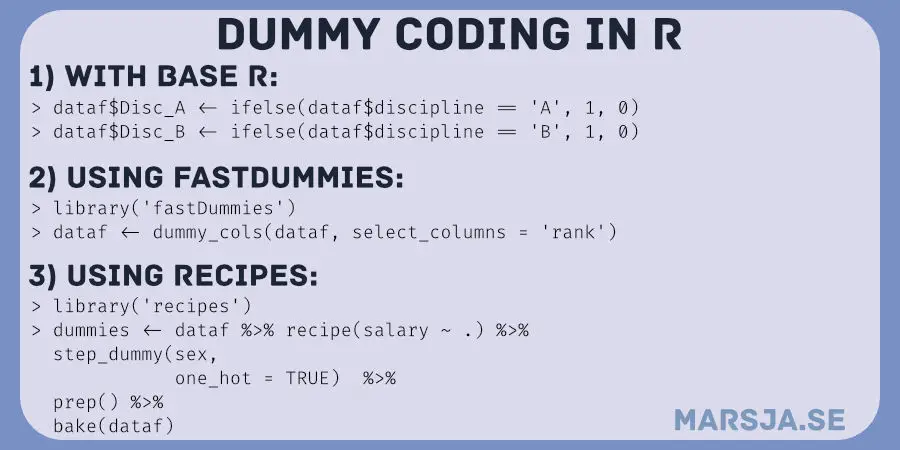
In this tutorial, we will learn how to create dummy variables in R. Now, creating dummy/indicator variables can be carried out in many ways. For example, we can write code using the ifelse() function, we can install the R-package fastDummies, and we can work with other packages and functions (e.g. model.matrix). In this post, however, we will use the ifelse() function and the fastDummies package (i.e., dummy_cols() function). First, we will explain why we may need to dummy code some of our variables.

dummy coding in R

Outline

In the first section of this post, you will learn when we need to dummy code our categorical variables. This section is followed by a section outlining what you need to have installed to follow this post. For example, this section will show you how to install packages that you can use to create dummy variables in R. Now, this is followed by three answers to frequently asked questions concerning dummy coding, both in general but also in R. Note, the answers will also give you the knowledge to create indicator variables.
three ways to create indicator variables in R
Three Ways to Create Indicator Variables in R

Finally, we are going to get into the different methods that we can use for dummy coding in R. First, we will use the ifelse() function, and you will learn how to create dummy variables in two simple steps. Second, we will use the fastDummies package, and you will learn three simple steps for dummy coding. The fastDummies package is also much easier to work with when you, e.g., want to make indicator variables from multiple columns. Therefore, there will be a section covering this and removing columns we no longer need. In the following section, we will also look at how to use the recipes package for creating dummy variables in R. We will also cover dummy coding based on multiple conditions. Before concluding the post, we will also learn about some other available options.


Read more

Pandas Tutorial: Renaming Columns in Pandas Dataframe

Renaming columns in Pandas can be a lifesaver when working with data. Sometimes, we might receive data from a colleague or download it from the internet, and the column names might not be informative or consistent with our analysis. This could lead to confusion and errors in data interpretation, so it’s essential to know how to rename columns in a pandas dataframe.

For instance, imagine you are working on a project where you have to analyze data collected from multiple sources. Each source might use different column names, making comparing and combining datasets difficult. Renaming the columns can help standardize the names, making it easier to work with the data.

Thankfully, pandas provide a straightforward way to rename columns in a dataframe, allowing us to manipulate data quickly and efficiently.

This Pandas tutorial will cover the basics of renaming columns in pandas. We will start by exploring how to rename a single column, then move on to renaming multiple columns simultaneously. We will also learn to rename columns while importing data and change column names to lowercase. By the end of this post, you will have a solid understanding of how to rename columns in pandas and how to apply these skills to your data analysis projects.

Outline

The structure of this post is designed to provide you with a comprehensive guide on how to rename columns in a Pandas dataframe. First, we look at the general syntax of the rename method that we can use to change the name of a variable.

Second, we outline the prerequisites for following this post’s instructions. We then look at the example data we will work with throughout the guide.

The heart of the post lies in teaching you how to rename a column in a Pandas dataframe. Example 1 demonstrates a step-by-step approach to renaming columns, emphasizing practical implementation. In Example 2, we showcase an alternative method of renaming columns.

We also explore the ability to rename columns while importing data, offering insights into streamlining the data preprocessing pipeline. Additionally, we address how to rename grouped columns in a Pandas dataframe, a skill that can improve data organization.

Moreover, we look at changing column names to lowercase, enhancing the consistency and readability of the data. To accommodate different learning preferences, we provide a video tutorial that visually walks you through renaming columns using Pandas.

This post equips you with the knowledge to rename columns effectively within a Pandas dataframe.

How to Rename a Column in Pandas Dataframe

First of all, renaming columns in Pandas dataframe is very simple: to rename a column in a dataframe we can use the rename method:

df.rename(columns={'OldName':'NewName'},
inplace=True)Code language: Python (python)

In the code example above, the column “OldName” will be renamed “NewName”. Furthermore, using the inplace parameter makes this change permanent in the dataframe.

Read more

Reverse Scoring using R Statistical Environment

reverse scoring in R

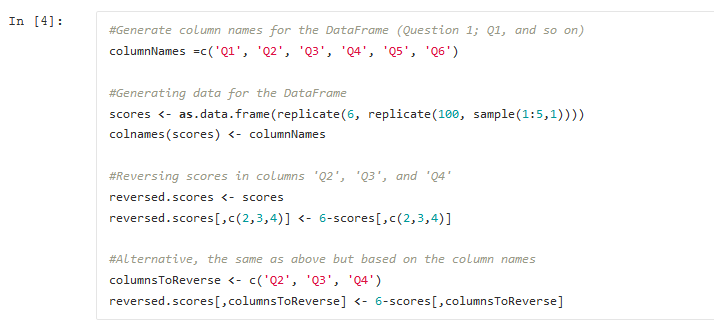
In this tutorial, you will learn how to do reverse scoring in R. Specifically, we will use 1) base R to reverse selected variables (e.g., questionnaire items), and 2) we will use the Psych package.

Reverse scoring

Many instruments (e.g., questionnaires) contain items phrased so that a strong agreement indicates something negative (e.g., “When there is music in the room, I find it hard to concentrate on reading”). These items need to be reversed so that the data will be correct later for statistical analysis.

Reverse Scoring in R

For more information on reverse scoring, please see my earlier post: Reverse scoring in Python. Since I was more familiar with Python than R and had no clue how to do this in SPSS, I wrote a Python script. The Python script used a function that used Pandas DataFrame, and it reversed the scores nicely and quickly.

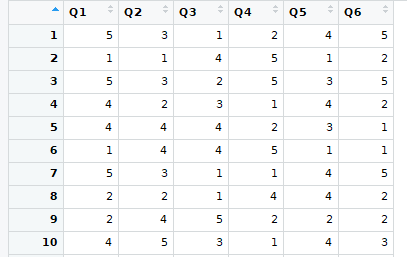
Questionnaire data to be reversed

Read more