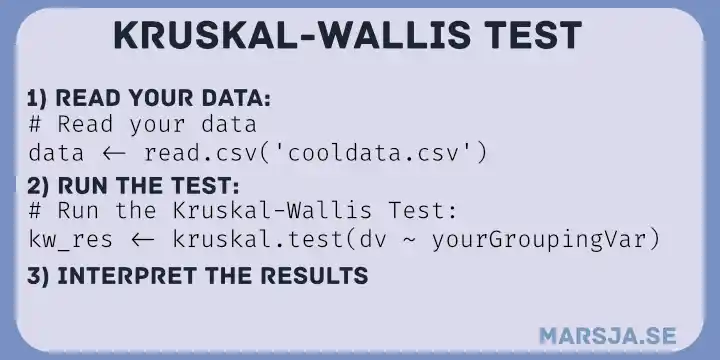
This post will teach you how to carry out the Kruskal-Wallis test in R. The Kruskal-Wallis test is a non-parametric statistical test used to determine whether there is a significant difference in the median values of two or more independent groups. This method is used when the analyzed data is not normally distributed, or the sample size is small. In addition, when the normality assumption is violated, the Kruskal-Wallis test is used instead of the traditional one-way analysis of variance (ANOVA).
non-parametric
How to Perform Mann-Whitney U Test in Python with Scipy and Pingouin
In this data analysis tutorial, you will learn how to carry out a Mann-Whitney U test in Python with the packages SciPy and Pingouin. This test is also known as Mann–Whitney–Wilcoxon (MWW), Wilcoxon rank-sum test, or Wilcoxon–Mann–Whitney test and is a non-parametric hypothesis test.
Outline of the Post
This tutorial will teach you when and how to use this non-parametric test. After that, we will see an example of a situation when the Mann-Whitney U test can be used. The example is followed by how to install the needed package (i.e., SciPy) as well as a package that makes importing data easy and that we can quickly visualize the data to support the interpretation of the results. In the following section, you will learn the two steps to carry out the Mann-Whitney-Wilcoxon test in Python. Note we will also look at another package, Pingouin, that enables us to carry out statistical tests with Python. Finally, we will learn how to interpret the results and visualize data to support our interpretation.