
In this blog post, you will learn how to carry out a countif function using base R and dplyr. Countif is a powerful function that allows you to count the number of times a certain condition is met in a dataset.
Countif is particularly useful in cognitive hearing science, where researchers often need to analyze large datasets of auditory signals. For example, you might want to use countif to count the number of times a particular sound occurs in a recording, or to count the number of times a listener correctly identifies a target sound in a speech recognition task.
The countif function can be applied to various data types, including vectors, matrices, and data frames. However, this blog post will focus on using countif on dataframes.
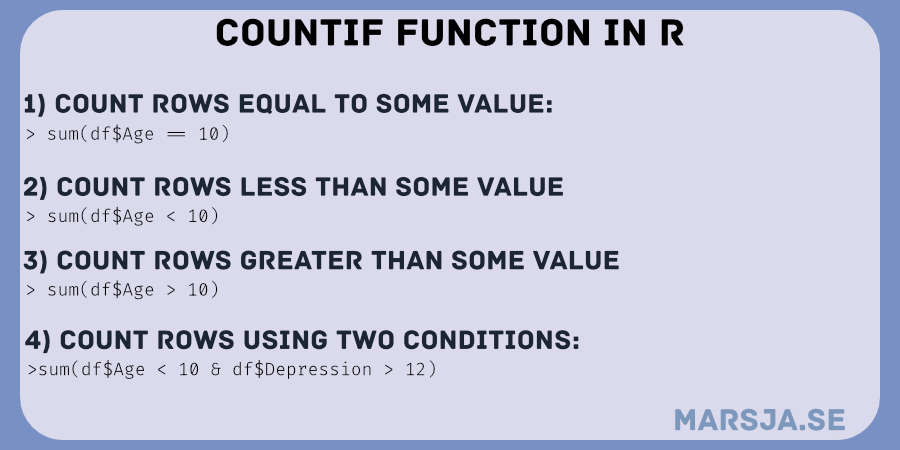
We will start by exploring how to use the base R function called sum(). We will show you how to use sum() to count the number of rows in a data frame that meets a specific condition.
Next, we will introduce the dplyr package, which provides a more intuitive syntax for data manipulation. We will show you how to use the mutate() and sum() functions in dplyr to achieve the same result as the sum() function many times.
Finally, we will create a custom countif function that combines the power of base R and dplyr. Our custom function will allow you to easily count the number of rows in a data frame that meet a specific condition, using a simple and intuitive syntax.
By the end of this blog post, you will have a deep understanding of how to use the countif function in R to analyze and manipulate data frames in cognitive hearing science.